Saturday, 13 October 2012

Glass sheathing the deck

Rae mixing epoxy.
Last month Rae and I glass sheathed the deck on Zephon. This is the first time we have glassed a deck and happily all went well (There were the odd tense moments, mainly me getting tetchy).  It is amazing how long it takes to wet out the glass cloth properly, Zephon is only 21 ft long and it took us about 7 hours in total to complete this task.

Preparation, being organized and making sure you work in the optimum environment is key to success (we were exceptionally lucky with the weather). The glass cloth and epoxy system used was 300 gm woven roving and West System epoxy. We also used peel ply which was well worth the extra effort and cost as the finish it leaves is amazing.

Epoxy is a nasty, environmentally unfriendly product. It is very important to make sure that you protect yourself and the environment from this product (always read the data sheet).


Peel ply in-situ. 

With this environmental fact in mind it was with a heavy heart that we opted to glass sheath Zephon's deck. I had considered re-canvassing the deck but the sad fact is that if done correctly the glass deck is more durable and will last much longer than canvas, I dare say there are some of you that will disagree and I am happy to be corrected on this point. 

Monday, 10 September 2012

Preparation is key before glass sheathing a deck

The paint has been stripped from the top sides. Note the gap between deck and plank that will need to be filled with epoxy as will the screw holes.

Finally I am almost ready to glass sheath Zephon's deck. Rae and I are planning on sheathing the deck on Saturday. In the meantime there is still a lot to be done, preparation is key to ensuring that the deck lasts for the next 25 years.

The deck has been stabilized (any deck planks that moved have been re-fastened) the deck has been belt sanded diagonally to make it as fair as possible (the deck planks have cupped over the years and obviously this cupping had to be got rid of before laying the plywood).  Once the deck was faired it was then primed using metalic pink primer. Patterns were made using strips of cheap 3mm plywood. The strips were laid and cut to fit, scribing as necessary. The patterns were held together by staples, a glue gun would be a good alternative. The patterns were laid on the plywood panels, secured in place and carefully drawn around before being cut-out using a jigsaw.  The back face and edges of the panels have been sanded with 80 grit prior to being given a coat of epoxy before being bedded in position on roofing felt adhesive tar.

The plywood I am using is good quality 6mm marine ply. This plywood is Lloyds approved and it should last 25 years. The plywood panels have been fastened with size 8 silicon bronze 3/4" grip fast nails. The edges of the ply have been fastened using size 6 silicon bronze 3/4" counter sunk wood screws. This should prevent any movement in the ply and hold it tight to the deck substructure. This is very important as excessive movement will cause the epoxy to crack and allow water ingress which would be very disappointing in the extreme.  
This seam has been raked out ready for splining. 


The deck after belt sanding.

Blocking pieces on the port side.

Starboard side blocking pieces. 


Deck primed and pattern making about to commence.

Plywood panels in position.

Plywood panels after having a coat of epoxy to seal them.


Fastening the plywood in position.


The bedding compound: Roofing felt adhesive tar.


Note the slight plywood overhang round the edges. This will be trimmed fair.


The deck prisms have been counter sunk into the ply. These prisms will obviously be removed when sheathing the deck.


Monday, 13 August 2012

My finger is pretty much healed and the new corner post is fastened

Well, my finger is healed but disappointingly there is almost no scar! I was looking forward to proudly showing off my latest war wound but the nurse did far too good a job of repairing me!

Work on Zephon has been slow recently as its the summer holidays and my children are staying with me which is wonderful. We have been doing lots of rowing and yesterday caught mackerel for supper and saw a seal too.   As well as having fun with the boys I have also been doing work on a boat called Summer Song (I have replaced the engine beds).

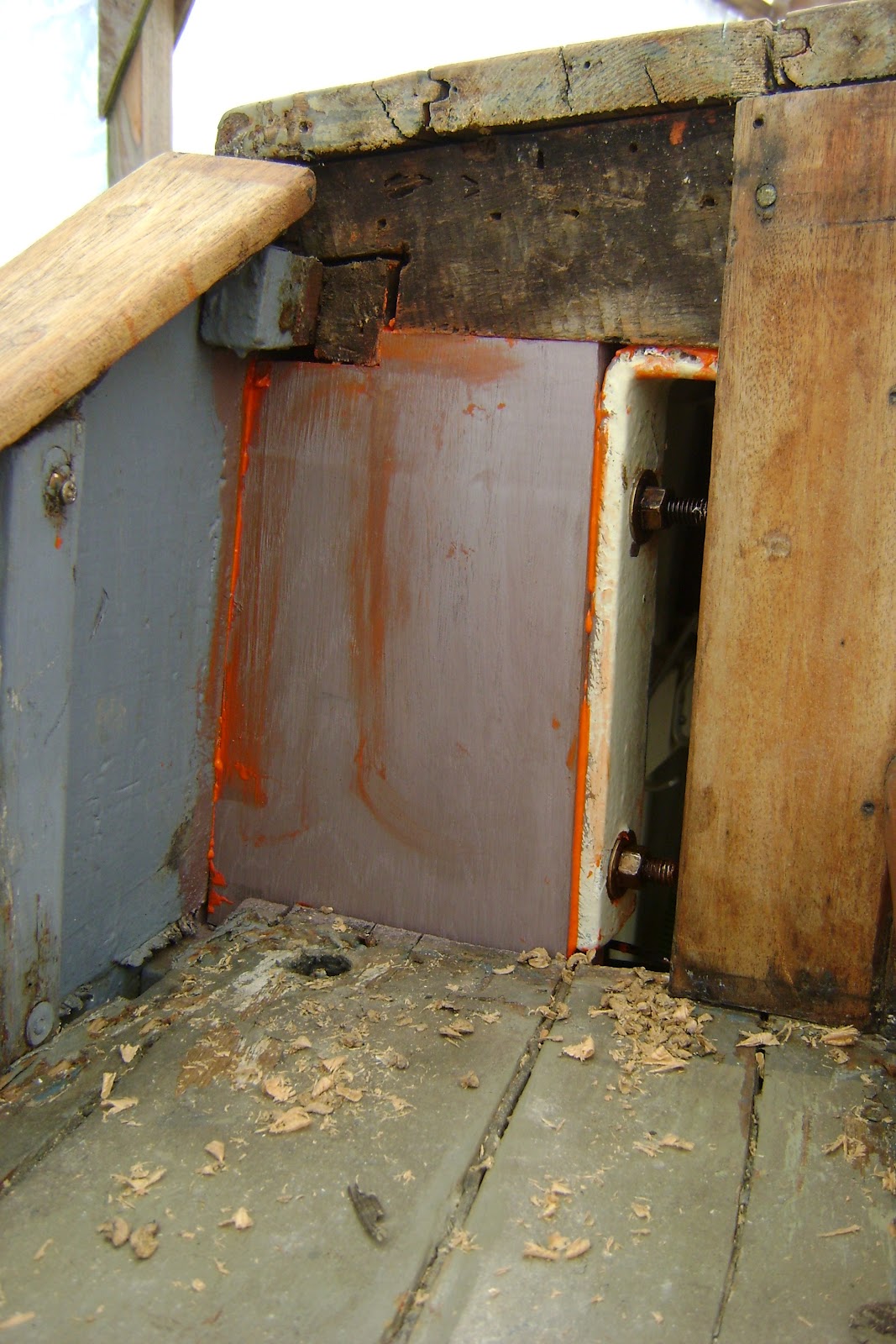
I did manage to do a days work on Zephon last Thursday and the new corner post is now fastened in place and looking good. The next job is to replace the tongue and groove (T&G) panelling that was soft and had to be removed to access the rotten corner post. Happily, about a year ago, I acquired some lovely old iroko T&G from a boat I was dismantling. This T&G is very similar to that on Zephon and so I am going to use this as its replacement.  


The old and new corner posts.

Corner post primed and ready to go.

The corner post fastened in place.


View from inside the cabin.

Summers Songs new engine beds.


Wednesday, 18 July 2012

Surfacer Thicknesser Planer - 1, Finger - 0


Today I am writing this with my middle finger on my right hand recovering after being crushed between the out feed rollers on the thicknesser planer and the bit of oak I was planing for the new corner post I am making for Zephon.

The trouble started when the feed rollers stuck. I tutted to myself and went to the end of the planer and gave the lump of oak a pull at which point the rollers started working pushing the oak lump over my finger and sandwiching it between the out feed rollers. I managed to free my hand and anxiously looked at the gaping wound on my finger which was quickly swamped by lots of crimson blood, I have to confess that I briefly felt a bit faint.  Blood dripped as I  swore with the realisation that I needed to go to hospital.

My mate Kim took me first to the Dartmouth Minor Injury Unit where the nurse there said I had to go to Torbay Hospital for an x-ray as my finger had been crushed. At Torbay Hospital after a long wait, nearly three hours, I was seen, given an x-ray (happily no broken bones) the wound was cleaned then sutured and bandaged and I was sent home. Thanks to the nursing staff and Kim.

The moral of this tale is always, always respect machinery and think before acting. As my mate Tom says "think: fingers and toes."

In my last post I talked about my partner Rae who has been ill with woody thyroiditis. Happily Rae is getting well and it is great to see her getting back to her normal self.

Moving the tent into position over Zephon
Tom's boat (Waif) is now back on the water and he has kindly donated his boat tent to me. So, two weeks ago, Zephon was craned to her new and much more protected position. The tent was then walked into place and secured.

These new working conditions are great and are making work much easier, the weather is still foul, in fact its raining as I am writing this post. Since last writing I have completed scraping the paint in the cockpit area and bilge where the engine is mounted. There have been no nasty surprises all the planking in this area is good. There is just a bit of refastening to be done to a couple of frames and the corner post on the port side needs to be replaced. Water has ingressed through the deck and has rotted the post out. When I discovered this rot  I was a bit anxious that there might also be rot to adjacent timbers but happily its just the post that is rotten.  Yesterday I removed the rotten post and began to make the new one when I injured my finger. So until my finger heals a bit work has stopped.

The boat under the blue cover is another Harrison Butler Zyclon,


Zephon in her new temporary home.


The paint has been stripped the planking and frames rubbed down and a thinned coat of pink metalic primer applied.


The rotten corner post uncovered whilst scraping paint.

A closer view.

The rotten corner post removed. 


Close-up view of the rot caused by water ingress.