Thursday, 14 February 2013

Work on the hull is nearly complete.

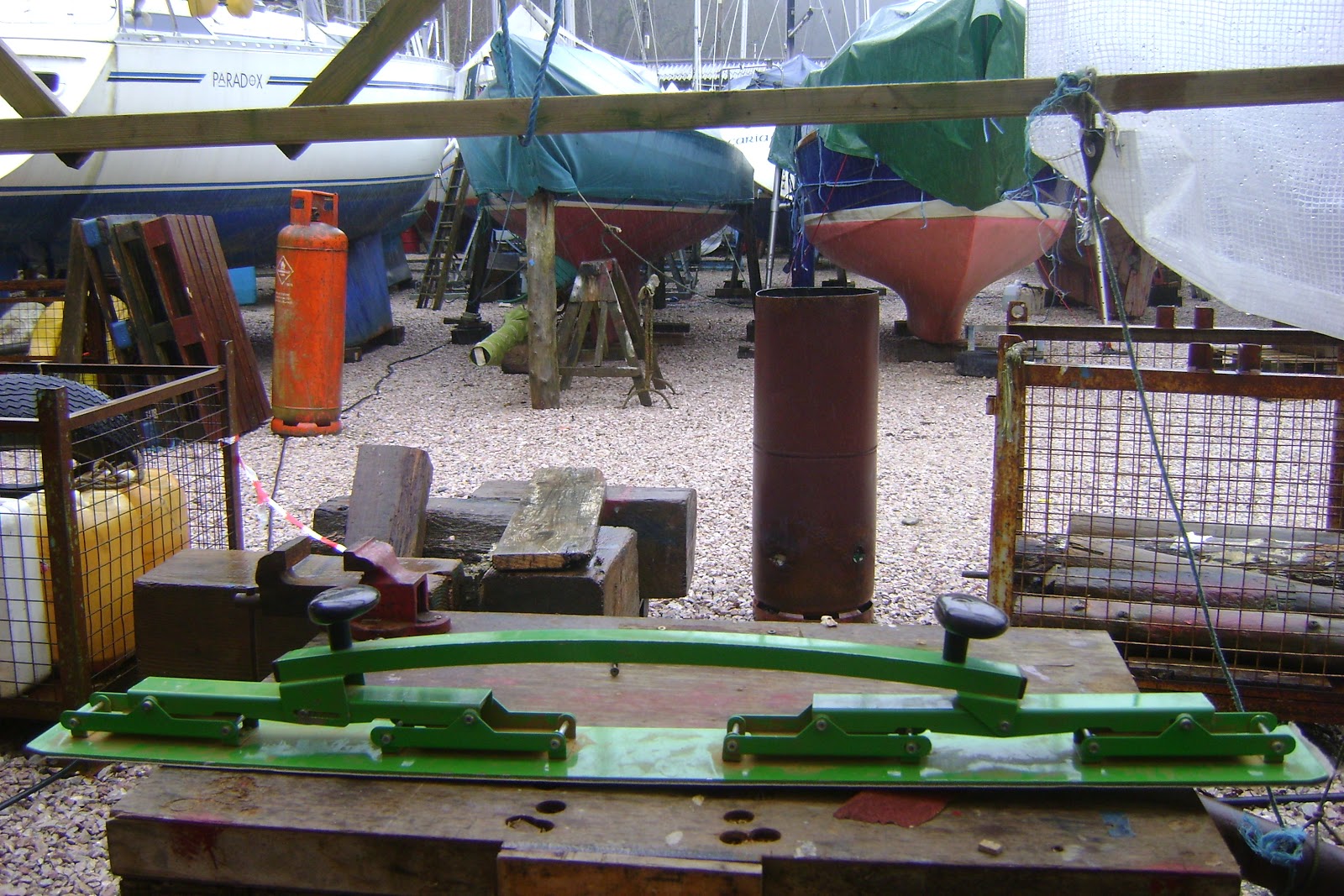
This is the long board I was talking about in my last post. These professional longboards are expensive. It is easy to make your own. A bit of ply the required length and width, add a couple of handles and stick the sandpaper on with contact adhesive and off you go.

Starboard side ready for priming and then paying the seams with red lead putty.

The seams are all payed.

Charmian on a wet and windy February day in the flooded dry dock. I spent last Monday helping to get her ready to leave the dock.  I believe Tommy Neilson is possibly going to be completing the work in Gloucester.


Hull primed and ready for fine filling.

I think the photos are all pretty self-explanatory so not a lot else to add. There is a bit more work to do to the keel. I am in the process of renewing the sacrificial dead wood aft of the ballast keel (the worm shoe, see my next post for full info on this). There are also a couple of graving pieces to do on the keel and then this can be primed. 

Once these jobs are done I shall be moving inside the boat to paint a second coat of primer in the engine bay and cockpit area and then scrape, sand and prime the bilges. I shall then modify the engine bearers in readiness for installing the reconditioned Yanmar 1GM 10. So all is still looking good for an April launch!

Friday, 25 January 2013

Working on the hull: raking, hardening the caulking and re-caulking where necessary; sanding, priming and paying-up the seams with red lead putty.

The seams after raking and the caulking has been hardened-up. The caulking is in good condition generally, there were a few spots that needed new caulking such as the garboard.


Port side is being worked on.
Progress with Zephon is good.  The target of getting her in the water for the end of April is looking achievable and the boat is starting to look great.  I am very pleasantly surprised with the overall condition of the hull which is very good. The seams are fine and most of the caulking is in very good condition. Zephon is caulked with cotton and even after some 60 odd years it still looks like it was put in yesterday!

I have re-caulked the stem and a small section of the garboard plank. I hardened-up all the seams and then primed them with Jotun pink primer. Once the seams had been primed I then used a long board (a 4 ft flexible board with handles that enables the hull to be sanded fair. Sorry I forgot to take a photo).  

With 60 grit attached to the long board I sanded the hull. It is important to sand at 45 degrees across the hull in both directions. This ensures that no unfairness is put into the shape of the hull. The angle of sanding will need to become shallower towards the stern of the boat as the compound curve of the hull increases. 
A graving piece on the stem.
Me paying-up the seams with red lead putty. It has been a bit chilly.

Once the hull had been fully sanded I then painted the hull with pink primer and then payed the seams with red lead putty. Needless to say red lead is highly toxic. I mix my own red lead into glazing putty. The ratio is simple; I continue mixing red lead into the putty until it is the same colour as the red lead in the tin. When mixing red lead always handle carefully. Place the red lead powder into a small amount of linseed oil and stir into a thick paste before kneading this paste into the putty. Mixing the powder with oil stops any red lead dust becoming airborne (wear a dust mask to protect yourself from inhaling red lead dust when mixing with linseed oil and wear gloves when handling as lead is easily absorbed through the skin).

Red lead is a traditional boat building product and in my view the best way to stop the seams as it keeps the putty flexible and so prevents the putty from cracking. If done correctly the payed-up seams should be good for years and years.


Port side seams all payed-up. Now to start on the starboard side!

Tuesday, 15 January 2013

Stripping paint from the hull.

Working for Butler & Co.
Caulking the topsides on the 66' trawler yacht Charmian.


Last September I went back to work full-time for Ashley Butler. I thought the work was only for two-three weeks. The work finally came to an end the week before Christmas.  The money was very welcome but this meant that poor old Zephon has been neglected for the past three months. I am now working back on her full-time and hope to get her back in the water for the end of April.


Burning paint off the hull

Burning and scraping paint is boring and time consuming.

You just have to get into a rhythm and go for it!
Last week I burned the paint off the hull. This took three and a half days. I used a blow torch which is the only practical way of  removing the paint.
Half the hull done!
 I was very pleasantly surprised to see that the planking is in very good order. There were three graving pieces needed. These I have been done (photos to follow) I have also refastened the starboard garboard hood end. All the other hood end fastenings are fine. My next job will be removing the silicon in the seams (it is a very bad idea to use silicon to pay the seams mainly because nothing sticks to it and there is a risk that water will get behind it and become trapped which will cause rot). I will need to check the condition of the caulking which might need hardening-up or renewing. I will use red lead putty to pay the seams once the hull as been sanded.
Seals hauled out on the river Dart.

Saturday, 13 October 2012

Glass sheathing the deck

Rae mixing epoxy.
Last month Rae and I glass sheathed the deck on Zephon. This is the first time we have glassed a deck and happily all went well (There were the odd tense moments, mainly me getting tetchy).  It is amazing how long it takes to wet out the glass cloth properly, Zephon is only 21 ft long and it took us about 7 hours in total to complete this task.

Preparation, being organized and making sure you work in the optimum environment is key to success (we were exceptionally lucky with the weather). The glass cloth and epoxy system used was 300 gm woven roving and West System epoxy. We also used peel ply which was well worth the extra effort and cost as the finish it leaves is amazing.

Epoxy is a nasty, environmentally unfriendly product. It is very important to make sure that you protect yourself and the environment from this product (always read the data sheet).


Peel ply in-situ. 

With this environmental fact in mind it was with a heavy heart that we opted to glass sheath Zephon's deck. I had considered re-canvassing the deck but the sad fact is that if done correctly the glass deck is more durable and will last much longer than canvas, I dare say there are some of you that will disagree and I am happy to be corrected on this point.